Scaling Observability: How OpenChoreo and OpenTelemetry Are Redefining the Internal Developer Platform

Modern software development has reached a critical juncture where the complexity of distributed systems often eclipses the speed of delivery. As organizations transition toward cloud-native architectures, the burden of managing infrastructure—building, testing, deploying, and maintaining—has increasingly fallen on developers. Internal Developer Platforms (IDPs) have emerged as the industry’s primary response, promising a "golden path" that abstracts away the underlying Kubernetes complexity. However, a significant challenge remains: observability. With a fragmented landscape of tools and data silos, monitoring has evolved from a simple monitoring task into a complex platform engineering problem.
On October 27, 2026, the team behind OpenChoreo, a CNCF Sandbox project, highlighted a significant shift in how platform engineers address this friction. By leveraging the OpenTelemetry (OTel) framework, OpenChoreo has created a modular, open-source IDP that treats observability not as an afterthought, but as a core architectural pillar. This development marks a maturation in the platform engineering space, where the goal is no longer just deployment, but deep, integrated understanding of system behavior.
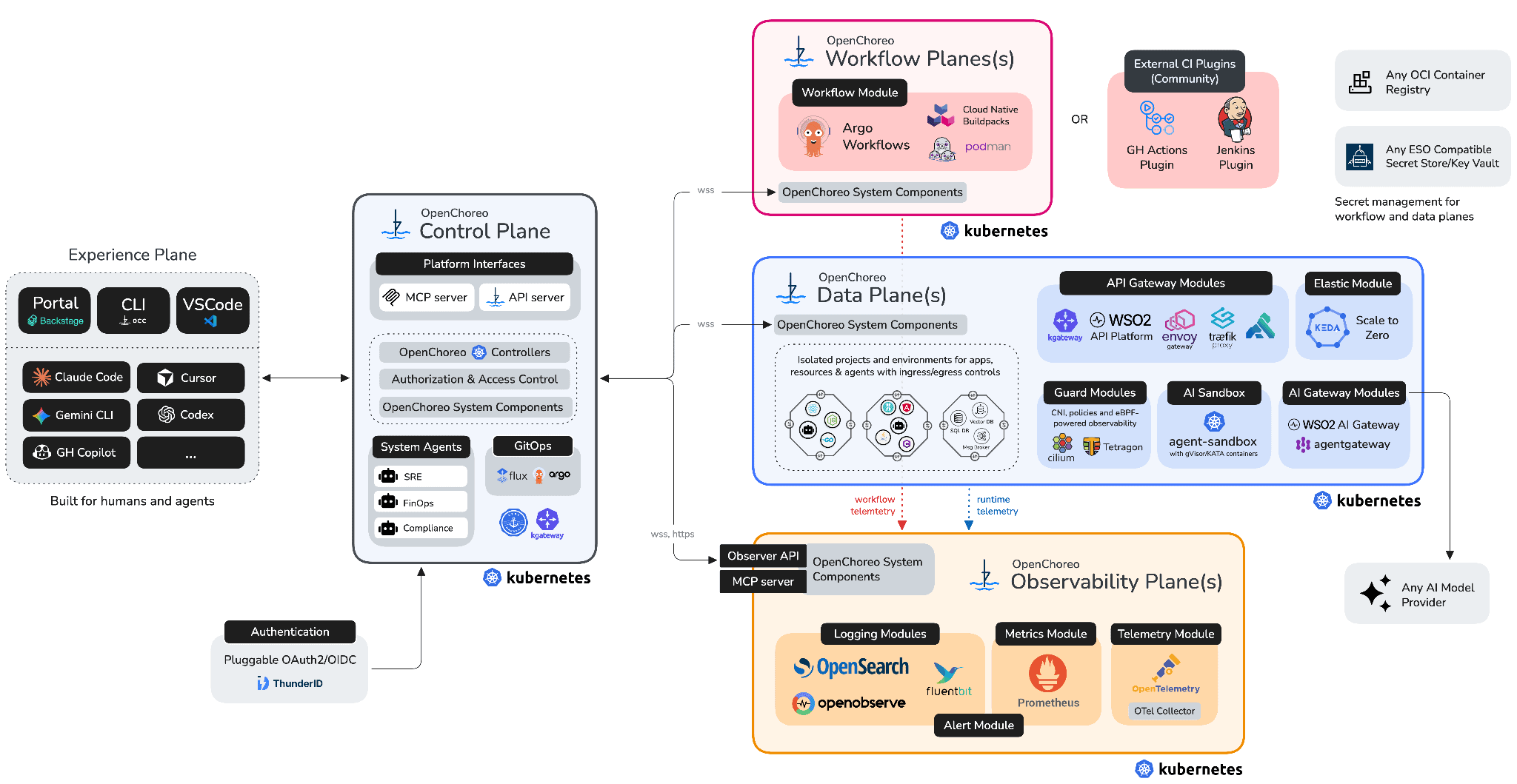
The Architectural Blueprint: Planes of Operation
To understand the role of observability in OpenChoreo, one must first look at its modular design. The platform decomposes the traditional Kubernetes-based development environment into specific "planes," each serving a distinct function. The control plane maintains the platform’s state, while one or more data planes handle the actual execution of application workloads. To facilitate the development lifecycle, optional workflow planes manage CI/CD processes, and an observability plane serves as the central nervous system for telemetry data.

Sitting atop these is the experience plane, which provides a unified interface for both human developers and AI agents. By utilizing a Backstage-based portal, a command-line interface (CLI), and integrated IDE support, the platform ensures that developers interact with a consistent set of tools regardless of the underlying complexity.
The central component of the observability plane is the "Observer." Designed with a hexagonal—or "ports and adapters"—architecture, the Observer ensures that the platform is not vendor-locked. Inbound ports receive logs, metrics, and tracing data, while pluggable adapter APIs allow platform teams to swap storage backends—such as OpenSearch, AWS X-Ray, or Google Cloud Trace—by simply updating a Helm chart rather than re-engineering the platform.
Solving the Visibility Gap with OpenTelemetry
OpenTelemetry has become the de facto standard for telemetry data collection, and OpenChoreo’s implementation highlights why. By using the OpenTelemetry Collector as the backbone of its observability strategy, the project addresses two of the most persistent issues in Kubernetes management: distributed tracing and the ephemeral nature of cluster events.
Distributed tracing is essential for debugging microservices, yet it remains difficult to implement consistently across large-scale systems. In OpenChoreo, developers instrument their applications using the standard OpenTelemetry SDK. Once the application exports spans via the OpenTelemetry Protocol (OTLP), the Collector pipeline handles the processing and routing. This approach ensures that developers can trace a request as it fans out across dozens of services, identifying bottlenecks or failures without needing to exit the portal interface.
Furthermore, the integration of an observability-focused Machine Learning Protocol (MCP) server means that AI agents can now consume this tracing data directly. This capability is significant, as it enables automated root-cause analysis, where AI assistants can parse complex trace maps to suggest fixes for latency issues or failing dependencies.
Persistence: The Kubernetes Event Challenge
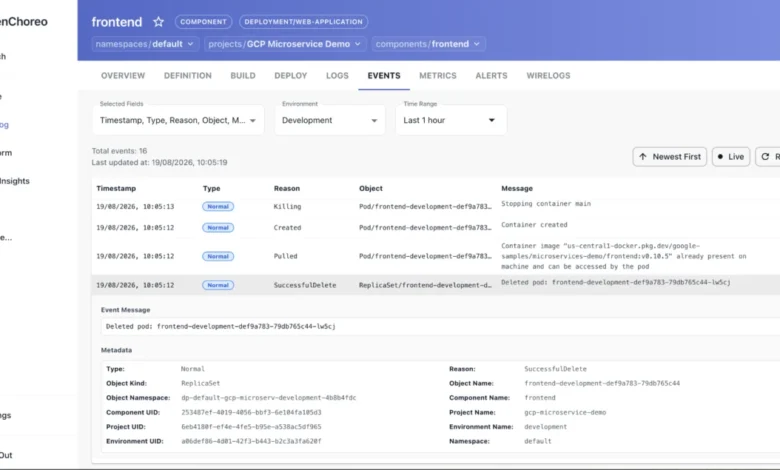
Perhaps the most innovative aspect of the OpenChoreo observability strategy is its approach to Kubernetes events. By default, the Kubernetes API server retains events for approximately one hour. This is a major pain point for platform engineers: when an incident occurs—such as a scaling failure during a peak traffic event like Black Friday—the diagnostic evidence is often purged by the time the investigation begins.
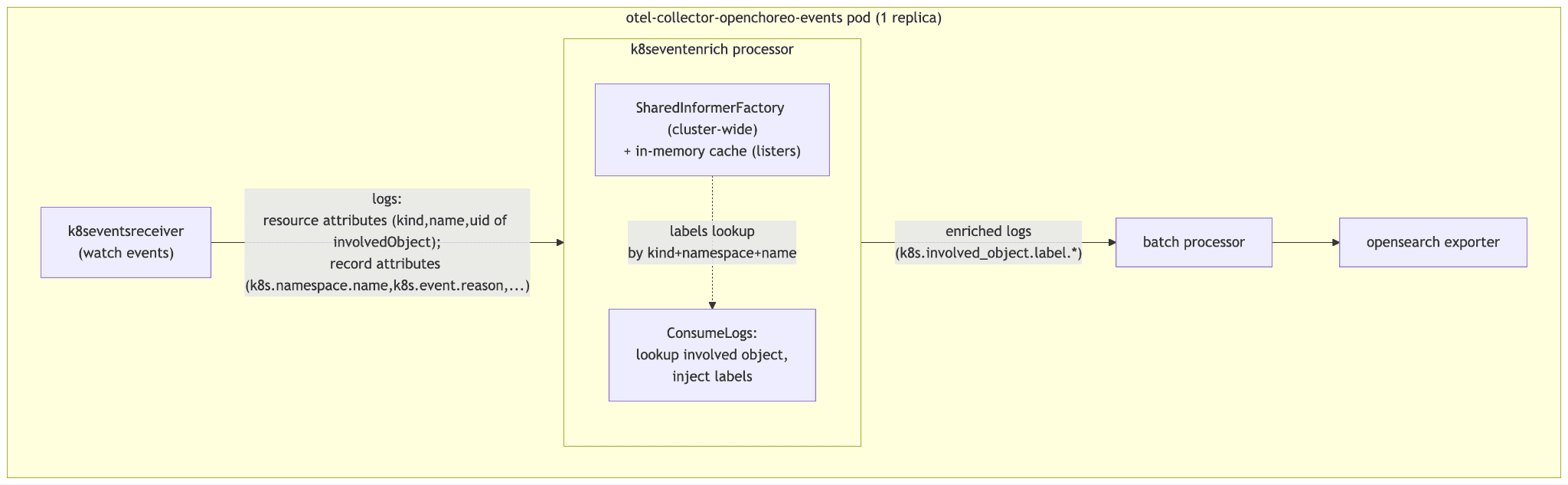
Furthermore, events are inherently noisy and difficult to associate with specific application workloads. OpenChoreo addresses this by deploying a purpose-built OpenTelemetry Collector distribution. This distribution features a specialized processor that enriches events using an in-memory informer cache. By attaching metadata—such as project, component, and environment tags—to each event, the platform transforms short-lived, cryptic log lines into persistent, actionable intelligence.
This implementation allows the OpenChoreo portal to display event history within the context of specific application components. By storing these enriched events in a long-term backend, teams can conduct post-mortems weeks after an incident, correlating infrastructure state with application performance.
Data-Driven Development: Why OpenTelemetry Prevails
The decision to adopt OpenTelemetry as the foundation for the observability plane was driven by four specific technical advantages that align with the goals of modern platform engineering:
- Vendor Neutrality: By adhering to open standards, OpenChoreo avoids proprietary lock-in. Platform teams can switch backend providers based on cost, performance, or compliance needs without disrupting the developer experience.
- Standardization of Telemetry: The use of OTLP ensures that data from disparate languages and frameworks is collected in a uniform format, reducing the overhead of maintaining custom exporters.
- Pipeline Flexibility: The Collector’s ability to process data—enriching, filtering, and sampling before it reaches the backend—drastically reduces the noise and cost associated with high-volume telemetry.
- Rich Ecosystem: The vast library of existing receivers and exporters in the OTel ecosystem allows OpenChoreo to integrate with almost any existing logging or metrics stack, making it highly adaptable for organizations with legacy infrastructure.
Implications for the Future of IDPs
The integration of OpenTelemetry into OpenChoreo reflects a broader industry trend toward "Observability-Driven Development." As organizations continue to scale their Kubernetes footprints, the sheer volume of telemetry data makes manual monitoring impossible. The move toward platforms that automatically instrument and persist diagnostic data is not merely a convenience; it is a necessity for maintaining system reliability in complex environments.
The use of AI-ready interfaces (such as MCP servers) further suggests that the next generation of IDPs will be designed for "co-pilot" operation. By exposing structured, rich telemetry to AI agents, platforms like OpenChoreo are effectively lowering the barrier to entry for junior developers and reducing the cognitive load on senior engineers.
Conclusion and Next Steps
The technical achievements demonstrated by OpenChoreo provide a blueprint for how other projects might address the observability gap. By standardizing on OpenTelemetry and focusing on the lifecycle of telemetry data—from creation to long-term storage—the project is helping to shift the operational burden away from the developer and back onto the platform.
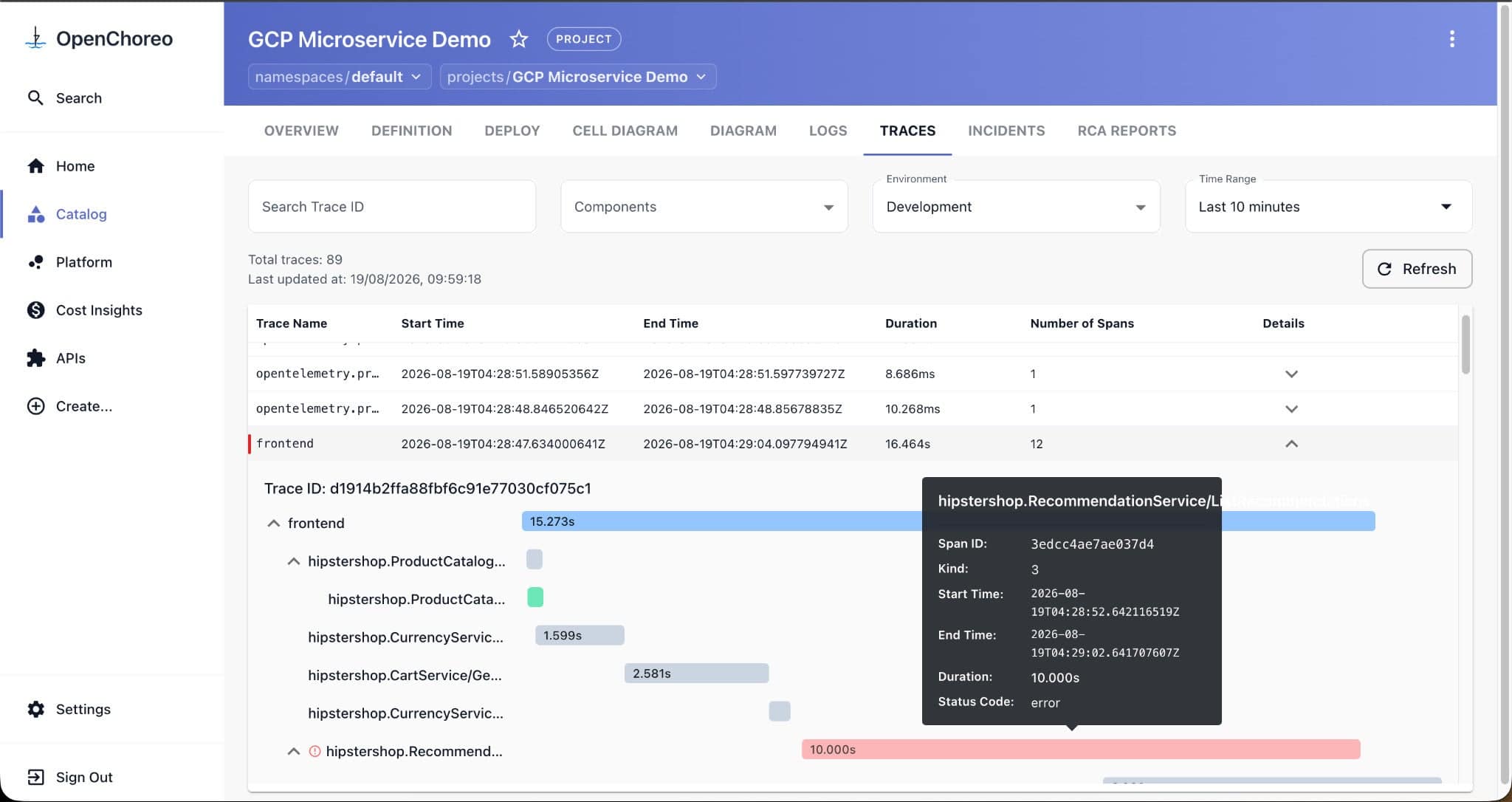
For teams looking to adopt this approach, the project maintains a comprehensive set of resources. The "GCP microservices demo," available in the OpenChoreo repository, provides a practical, hands-on example of how these concepts translate into real-world troubleshooting. As the project continues to evolve within the CNCF Sandbox, it will likely serve as a key reference point for how organizations build, secure, and monitor their internal platforms in an increasingly complex cloud-native world. Those interested in the technical nuances of this implementation can explore the project documentation on GitHub or engage with the community via the official Slack channels. The transition to a more automated, observable, and developer-centric infrastructure is well underway, and projects like OpenChoreo are leading the charge.